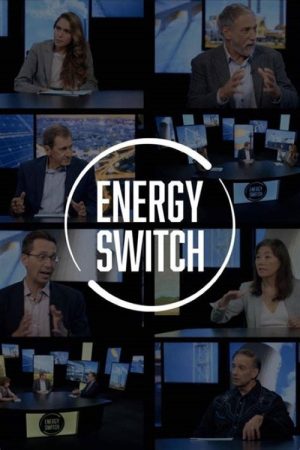
Energy Switch (2022) is a series web series in English. On New MovieLinkBD: full story, cast, ratings, season & episode guide, official trailer and where to watch Energy Switch online in HD.
Energy Switch — Storyline
Energy Switch brings together two renowned experts from government, NGOs, academia and industry, with differing perspectives on important energy and climate topics. Hosted by renowned global energy expert, Dr. Scott Tinker.
Cast & Crew
- Starring: Dr. Scott Tinker
Energy Switch — Series Details
| First Air Date | 2022-10-03 |
| Seasons | 8 |
| Episodes | 88 |
| Genre | series |
| Language | English |
| Status | Returning Series |
Energy Switch — Episode Guide
Season 1
- E1: How Should We Respond to Climate Change? (2022-10-03) — Dr. Steve Koonin, a former U.S. Secretary of Science, and Dr. Michael Greenstone, Director of the Energy Policy Institute at the University of Chicago, discuss how climate change i
- E2: Future of Natural Gas (2022-10-10) — Dr. Naomi Boness and Rachel Fakhry discuss the impact of hydraulic fracturing on the energy sector, its role in replacing coal with gas, and how this shift reduces, but doesn't eli
- E3: Solar & Wind Power the World? Part 1 (2022-10-17) — Robert Bryce and Leia Guccione discuss the potential for wind and solar to power the world, how these sources provide only 4% of global electricity today, and the challenges of sca
- E4: Solar & Wind Power the World? Part 2 (2022-10-24) — Leia Guccione and Robert Bryce discuss the potential to scale up solar and wind power, concerns over materials, mining, and land use, and whether these sources can one day power th
- E5: Is Hydrogen our Energy Future? (2022-10-31) — Countries are excited about hydrogen as a way to reduce their CO2 emissions, but costs need to come down and continued technological and manufacturing developments will be required
- E6: Investing in our energy future (2022-11-07) — Transitioning the developed world toward lower carbon energies, and the developing world toward having enough energy, are grand and sometimes conflicting challenges. Both will cost
- E7: New Geopolitics of Energy (2022-11-14) — The world is changing – and so is the world of energy. Many experts think coal, oil and natural gas will remain our largest global energy sources. Meanwhile, solar and wind become
- E8: More Nuclear Power? Part 1 (2022-11-21) — Nuclear proponents say we can't meet climate goals without expanding the fleet and pursuing new nuclear technologies, while opponents say cost and time are the main issues. Will nu
- E9: More Nuclear Power? Part 2 (2022-11-28) — If we are to meet decarbonization targets, each nuclear plant could take over a decade to permit and construct, while alternatives could be deployed in a few years. The conversatio
- E10: Making Energy More Sustainable (2022-12-05) — Energy sustainability can be grouped into three areas: Environmental: can an energy resource operate in equilibrium with the environment? Sociopolitical: do its benefits enrich bro
- E11: Policies to Reduce CO2 (2022-12-12) — Carbon-based fuels provide more than 80% of global energy. To reduce emissions will take time and money. What are the benefits of a carbon tax? Or would it be more effective to enc
- E12: Does the US Need Oil & Gas Industry? (2022-12-19) — The oil and gas industry provides 10 million US jobs and billions to the economy. Cheap, available oil makes transportation and products affordable. Abundant gas has offset coal in
Season 2
- E1: Could LNG Change Global Energy? (2023-04-03) — Liquifying natural gas and shipping it around the world in tankers could make it available to all at a global market price. While this could boost industry and help developing nati
- E2: Understanding the Electric Grid, Part 1 (2023-04-10) — The electric grid, and all its attached generators and transformers, has been called the largest machine in the world. In part 1, we'll discuss how it powers our lives and the mode
- E3: Understanding the Electric Grid, Part 2 (2023-04-17) — The electric grid powers our cities and industry, workplaces, homes and increasingly, our cars. For that, we'll need more electricity, and we'd like it to be lower carbon. Can we b
- E4: Good News About Climate Change? (2023-04-24) — Recent IPCC reports show less warming than predicted a decade ago. Emission growth is slowing, but has not yet plateaued, and while climate scientists say we're not on track to mee
- E5: Environmental Impacts of Energy on Air (2023-05-01) — CO2 emissions from energy get most of the attention, but there's a more immediate concern: particulate air pollution. Burning coal, wood, diesel and animal dung causes millions of
- E6: Could Artificial Intelligence Change Energy? (2023-05-08) — Artificial intelligence and machine learning could improve energy efficiency and allow for better prediction of electricity resources. Are the algorithms and computing power suffic
- E7: Energy Impacts on Land (2023-06-04) — All energy facilities must be sited somewhere. All energy requires extracting something from Earth- fuel must be drilled for and materials must be mined. Transmission lines and pip
- E8: Batteries for Cars and Grids, Part 1 (2023-06-11) — Battery technology has already made incredible leaps, making electric vehicles commercially viable and attractive to consumers. Could it also revolutionize the electric grid itself
- E9: Batteries for Cars and Grids, Part 2 (2023-06-18) — What are the potential new materials to make batteries more affordable, safer and less environmentally impactful? What could this mean for the future? Lynden Archer, Dean of Engine
- E10: Is net zero by 2050 possible? (2023-06-24) — Countries, states and companies have pledged to get their greenhouse gas emissions to net zero by 2050. What technologies, policies and investments would this require? Is it likely
- E11: The Energy-Water Nexus (2023-07-02) — Energy and water are tightly linked. We use extraordinary amounts of energy for municipal water systems and irrigation. And we use huge volumes of water in energy too. How could we
- E12: How Do We Power the Developing World (2023-07-09) — 80% of the world lives in developing nations, but uses just 20% of global energy. To provide them access to a modern life, we'd need to double energy production globally. Can we do
Season 3
- E1: Nuclear Waste (2024-10-02) — The US is the only country with permanent storage for low and intermediate-level nuclear waste. But we're one of the few countries with nuclear power plants that don't have a plan
- E2: Carbon Capture and Storage (2024-10-09) — One solution to reducing carbon emissions is to capture and store them underground. But there are challenges in capturing, transporting and storing the CO2, and determining who wil
- E3: China's Energy and Climate Policies, Part 1 (2024-10-16) — China is the world's largest energy producer and consumer, the largest exporter of solar, the current leader in nuclear, and emits 1/3 of global CO2. This makes China's energy and
- E4: China's Energy and Climate Policies, Part 2 (2024-10-23) — While China continues to build coal plants, they intend to reduce their use, to manage local air pollution and meet peak CO2 and net zero goals, while prioritizing their energy sec
- E5: Students on the Future of Energy (2024-10-30) — Two advanced energy students share their thoughts on the future of nuclear, carbon capture and storage, solar and wind, batteries, energy reliability, climate change and their hope
- E6: What's New in Geothermal? (2024-11-06) — Geothermal energy can be found everywhere below the surface, at varying temperatures, depending on how deep and where you are. We can use it to warm homes and buildings, generate e
- E7: Electric Cars – Pros and Cons, Part 1 (2024-11-13) — Electric cars are fast and efficient and produce no local emissions. But they're also expensive, with issues around the metals for their batteries. Dr. David Rapson, Economic Polic
- E8: Electric Cars – Pros and Cons, Part 2 (2024-11-20) — Subsidies for electric cars have helped make them popular, but have gone mostly to the wealthy. These and mandates may have unintended consequences. We need more affordable EVs, ev
- E9: Solar Panel Recycling (2024-11-27) — Millions of solar panels are nearing end of life. Today they're going to landfills or interim storage because recycling is expensive and immature. We need to build a recycling syst
- E10: Critical Minerals for Energy (2024-12-04) — Critical minerals and rare earth elements, essential for new energy technologies, are largely controlled by China. Global supply and demand and potential new mines in the US are pr
- E11: EU Energy and Climate Policy, Part 1 (2024-12-11) — Europe is in an energy crisis, which has encouraged a 'war mentality' about energy and climate, and fast-tracked new energy projects. What will this mean for the continent and its
- E12: EU Energy and Climate Policy, Part 2 (2024-12-18) — Europe's energy crisis has fostered cooperation between member states and the EU governing body and strengthened the push for more wind and solar though some call for technological
Season 4
- E1: Nuclear Fusion (2024-04-01) — Fission, the splitting of atoms, makes the heat that drives our nuclear reactors. Fusion, the fusing together of atoms, powers the stars, including our sun — which means that fusi
- E2: Food: Energy & Emissions (2024-04-08) — Everything in our modern lives has energy inputs and emissions outputs — and that's certainly the case for our food. It's not just all the energy that powers the equipment require
- E3: How to Decarbonize Industry, Part 1 (2024-04-15) — Cement and steel have created the modern world: they make our buildings, roads, machines and products. These two industries emit nearly as much CO2 as our entire electricity system
- E4: How to Decarbonize Industry, Part 2 (2024-04-22) — In Part 1 of this discussion, we heard ideas to decarbonize cement and steel. We'll conclude with a look at fertilizer, which has made modern agriculture possible, and petrochemica
- E5: Energy and Climate Paradoxes (2024-04-29) — There are many paradoxes in climate and energy: people want energy for their homes and cars but don't want new power lines or pipelines that could provide it. Nuclear is a zero-car
- E6: Energy for Africa (2024-05-06) — Six hundred million people in Sub-Saharan Africa do not have modern energy — so African nations are working to develop their energy resources. For many, the energy they do have co
- E7: Sea Level Rise (2024-05-13) — Sea level has been rising since the end of the last Ice Age, when continental ice sheets began to melt. In island nations and low-lying coastal areas sea level rise is contributing
- E8: Critical Risks to Energy Systems (2024-05-20) — The US energy system, particularly our electric grids and pipelines, is constantly at risk from extreme events, like hurricanes, winter storms, heat waves and wildfires. And increa
- E9: Electric Grid Reliability (2024-05-27) — Everything in the modern world relies on the electric grid. To keep the grid reliable, system operators order electricity from dispatchable generation, like coal, gas, hydro and nu
- E10: Students' Energy and Climate Opinions (2024-06-03) — For our ongoing 'youth voice' series, we created an energy and climate survey and asked two current and recently graduated university students to help administer it to hundreds of
- E11: India's Energy and Climate Policies, Part 1 (2024-06-10) — India is the third largest energy consumer and carbon emitter in the world, with the fastest growing energy demand. Today coal makes three-quarters of their electricity, with the o
- E12: India's Energy and Climate Policies, Part 2 (2024-06-17) — In part 1, we focused on India's electricity, and the potential to expand it using coal and/or solar. We continue with the growth of 2- and 3-wheel electric vehicles in India, the
Season 5
- E1: Plastic Recycling (2024-09-30) — Plastic is cheap, lightweight, strong and versatile, so we use it in millions of products. But there are challenges with disposal and recycling, meaning plastic is increasingly in
- E2: How to Build Powerlines (2024-10-07) — Everyone loves electricity…and no one loves powerlines. But we need more of them. New lines face many challenges, in permitting, siting and eminent domain; allocating costs among s
- E3: Urgency of Climate Change, Part 1 (2024-10-14) — Warming temperatures and their potential impacts are predicted to escalate in the coming decades. Dr. Andrew Dessler, a climate scientist, argues for urgent action to reduce emissi
- E4: Urgency of Climate Change, Part 2 (2024-10-21) — To wrap up this discussion, Dr. Bjorn Lomborg and Dr. Andrew Dessler lay out their strategies for addressing climate change. One favors adaptation, and tackling other pressing glob
- E5: The Future of Biofuels (2024-10-28) — We use a lot of biofuels in the US — corn ethanol now makes up 10% of every gallon of gasoline. Ethanol made from cellulose, from agricultural waste or non-food crops, has been in
- E6: Jobs in Energy (2024-11-04) — Working in energy, particularly oil and gas, is not as popular as it once was in the US. Electricity and lower carbon energies are more readily embraced by young people. We’ll talk
- E7: Offshore Wind, Part 1 (2024-11-11) — The US is contemplating massive new offshore wind projects. Proponents see these as part of decarbonizing our electricity system. Opponents worry about impacts to fisheries, marine
- E8: Offshore Wind, Part 2 (2024-11-18) — In part 1, we talked about the size of planned offshore wind farms, and potential impacts to fisheries, marine mammals and property values. Now we discuss the cost to build offshor
- E9: Climate Journalism (2024-11-25) — General readers want straight answers on climate. But climate science is complex and full of nuance. This excites scientists, whose research explores the leading edge. But it makes
- E10: Natural Gas Pipelines (2024-12-02) — The US natural gas pipeline network carries gas from where it’s produced to the many places it's used: power plants, factories and millions of homes. Proponents want more pipelines
Season 6
- E1: Wildfires (2025-03-31) — There are more wildfires in some areas, though globally they’re down. Climate change contributes, but there are other factors which have made forests and cities more fire prone and
- E2: Small Modular Nuclear Reactors (2025-04-07) — Small reactors have been used on aircraft carriers for decades. Similar designs are now proposed for power generation and industrial heat. They could be built in factories and asse
- E3: Population (2025-04-14) — The common narrative about human population — that it will grow forever — is dead wrong. Demographic experts now agree that population will peak soon and begin to decline, with p
- E4: Climate Adaptation (2025-04-21) — To curb global warming, governments often focus on reducing CO2 emissions. But many are now also adapting to a changing climate, from expanding air conditioning and passive cooling
- E5: Carbon Markets, part 1 (2025-04-28) — Carbon markets were created to try to reduce CO2 emissions. There’s a compliance market, in which governments set emission limits and companies comply, often by trading credits. An
- E6: Carbon Markets, part 2 (2025-05-05) — In part 1, we explored compliance and voluntary markets. Now we look at brokers and traders, market forces that help set prices, the emissions reduction potential of low vs. high p
- E7: Hydropower (2025-05-12) — Using water to generate power has been a staple in our electricity system for a century. We look at conventional reservoir dams and pumped hydro storage; the state of hydropower in
- E8: Energy Justice (2025-05-19) — Energy is so intertwined with the functioning of society that it’s a basic need. Yet not all Americans have equal access to safe, reliable, affordable energy. We’ll discuss energy
- E9: Grid-Scale Batteries (2025-05-26) — Large-scale batteries on our power grid could balance the intermittency of wind and solar, along with the normal irregularities of the grid. And they’re becoming ever more affordab
- E10: Energy Subsidies (2025-06-02) — Subsidies support energy infrastructure and development to benefit consumers. And we pay for them. In tax credits for producers and investors. Direct payments and mandates for low
Frequently Asked Questions
How many seasons does Energy Switch have? 8 season(s) with 88 episodes.
Where can I watch Energy Switch? See the Where to Watch section above for current streaming options.